What is position control?
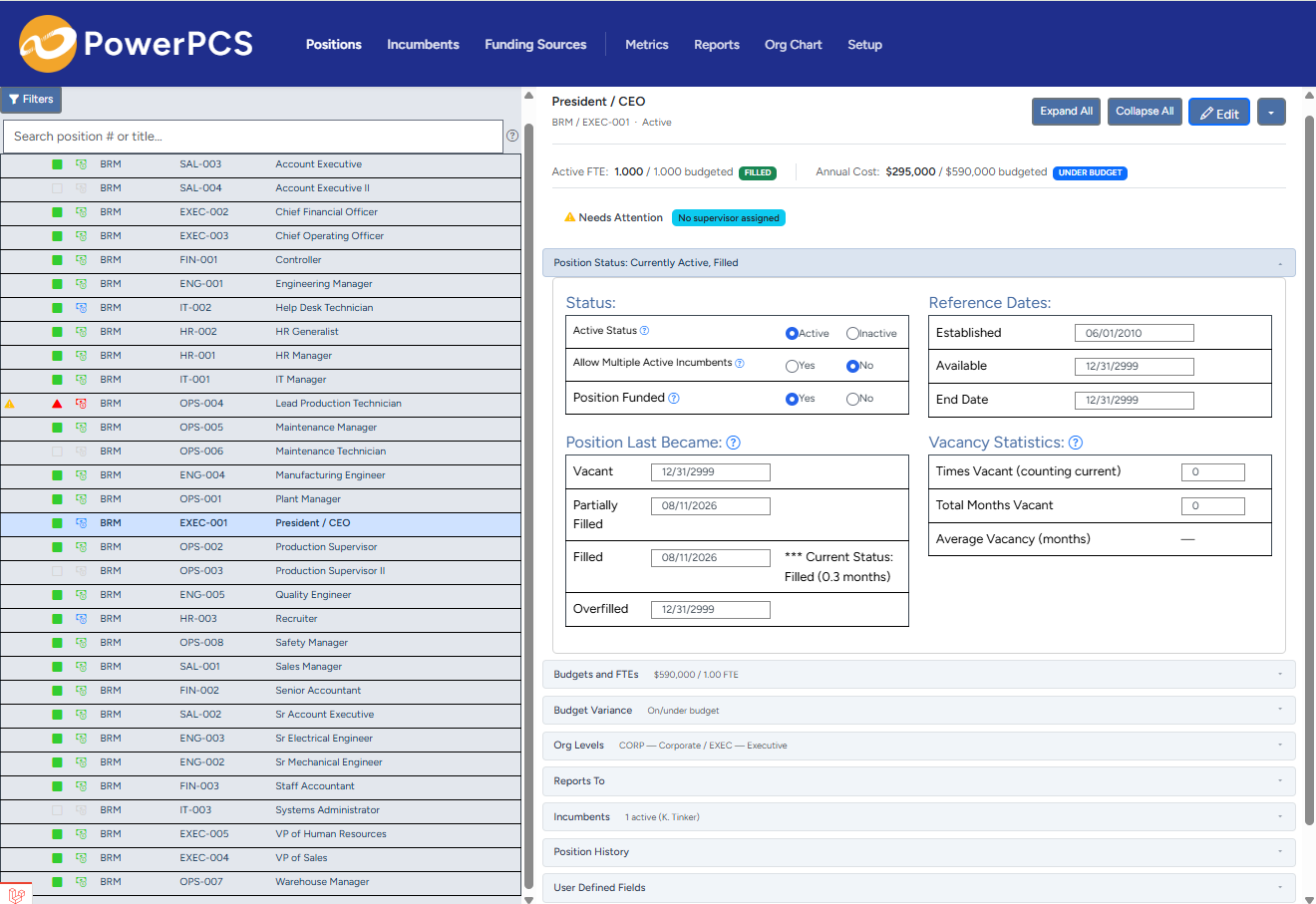
Position control is the practice of managing positions as distinct entities — separate from the employees who fill them. A position has a job title, a classification, a budget, an FTE allocation, and a place in the organizational hierarchy. It exists whether it is filled or vacant.
Want to try the idea in a spreadsheet first? Grab our free headcount & salary budget template — it puts budgeted positions next to the actual people in them and calculates the variance, so you can see position control in action before you adopt software for it.
This is different from how most HR software works. A typical HRIS tracks people, as opposed to the positions that people occupy. Position control tracks the position first, then who occupies it, with what FTE, and at what cost.
Simple way to think about it: When a nurse retires from a hospital, the nursing position doesn't disappear — it's now vacant. The budget for that position is still there, waiting to be filled. Position control software tracks that vacancy, its budgeted cost, and when a new hire eventually fills it. Without position control, that information lives in a spreadsheet — if it exists at all.
Do I need position control software?
If any of the following are true, the answer is probably yes:
- You manage headcount in a spreadsheet and Finance has different numbers than HR
- You can't quickly answer "how many positions are currently vacant, and what would it cost to fill them all?"
- Your organization ties budget authority to specific approved positions, not just a headcount number
- You manage grant-funded or program-funded positions with specific FTE and reporting requirements
- You've had budget overages caused by overfilled positions or positions that were filled outside the approved structure
- Your audit or board asks about headcount and you scramble to produce a coherent answer
Why it matters
Organizations that manage workforce budgets — where every position needs to be approved, budgeted, and tracked — need a system that mirrors how they actually plan headcount. That means:
- Knowing how many positions exist, and whether each is filled, partially filled, vacant, or overfilled, at any moment
- Tying budget to the position, not the person — so turnover doesn't create accounting gaps
- Maintaining a complete audit trail of every change: who filled what position, for how long, and at what FTE
- Being able to answer Finance's questions about headcount costs without a manual project
Who uses position control?
Position control has historically been used in sectors where headcount is tightly regulated by budget authority:
- Government agencies — every position requires legislative or board approval; unauthorized hiring is not allowed (see position control for government)
- School districts — positions are tied to school sites, funding sources (Title I, general fund, grants), and enrollment projections (see position control for school districts)
- Colleges and universities — faculty lines and staff positions tied to departments and to state, tuition, grant, and endowment funds (see position control for higher education)
- Healthcare organizations — positions are tied to departments, cost centers, and in some cases, licensing requirements
- Nonprofits — grant-funded positions carry specific FTE and duration requirements that must be tracked for compliance (see position control for nonprofits)
- Any mid-market organization where Finance and HR need to agree on what's budgeted vs. what's actually on payroll
Position control vs. traditional HRIS
Most HRIS platforms are employee-centric. An employee record is created at hire, updated over time, and terminated at separation. The "position" concept, if it exists at all, is often just a field on the employee record — not a standalone entity.
Position control flips this. The position is the anchor. Employees are linked to positions, not the other way around. When an employee leaves, the position remains. When an employee transfers, both positions are updated — the one they left and the one they joined.
Key distinction: A traditional HRIS only shows you actual headcount — who's currently employed. Position control tracks budgeted (or approved) headcount and actual headcount side by side, so reconciling the two is a quick check instead of a manual project. The gap between them — the headcount variance — is where budget overages, vacancies, and compliance issues hide.
Key concepts and terminology
Budgeted position
A position that has been formally approved to exist in the organization — typically through a budget process, board resolution, or organizational chart approval. Often called an "authorized position," especially in government and public-sector budgeting — same concept. Not every employer fills every budgeted position; vacancies are normal and expected.
FTE (Full-Time Equivalent)
A way of expressing how much of a full-time schedule a position represents. A full-time position is 1.0 FTE. A half-time position is 0.5 FTE. A position can be filled by multiple incumbents — for example, two half-time employees each at 0.5 FTE — as long as the total FTE doesn't exceed the position's budgeted FTE.
Incumbent
The person currently filling a position. A position can be vacant (no incumbent), partially filled (incumbent FTE below the budgeted amount), filled (incumbent FTE totals the budgeted amount), or overfilled (incumbent FTE exceeds the budgeted amount). Overfilled positions are a common source of budget overages.
Budgeted position cost
The annualized salary cost associated with filling a position at its budgeted FTE — pay rate only, not benefits or overhead. This is the number Finance uses to plan workforce budgets. It's tied to the position, not to whatever an individual employee happens to earn — though incumbent salary data informs actual cost reporting.
Position status
The current state of a position: filled, partially filled, vacant, or overfilled. Status is typically calculated automatically based on incumbent FTE assignments, not entered manually.
Change history / audit trail
A record of every change made to a position or incumbent over time — who changed what, when, and why. This is essential for compliance, budget reviews, and answering historical questions about headcount.
Position control vs. headcount management
These terms are often used interchangeably, but there's a meaningful difference. Headcount management is a broad term for tracking how many people work somewhere — usually just a count. Position control is more precise: it tracks the structure of positions, what each costs, who fills them, and at what fraction of full-time. You can do headcount management in a spreadsheet. Position control requires a system.
Position control also gets confused with position management — the HR/HRIS discipline of org structure and people movement. They're not the same thing, and the difference decides what software you should buy: see position management vs. position control. If you've decided position control is what you need, here's what to look for in position control software. And if you're in the UK, Ireland, Australia, or elsewhere in the Commonwealth, the same discipline goes by another name — see establishment control.